
Microchip MCP6004-I/SL Quad Op-Amp: Features, Applications, and Circuit Design Guide
The Microchip MCP6004-I/SL is a quad operational amplifier that has become a staple in low-power, low-voltage analog design. Part of Microchip's extensive portfolio of analog ICs, this op-amp is engineered for applications where power consumption and cost are critical constraints without sacrificing essential performance. This article delves into its key features, common applications, and practical design considerations.
Key Features of the MCP6004-I/SL
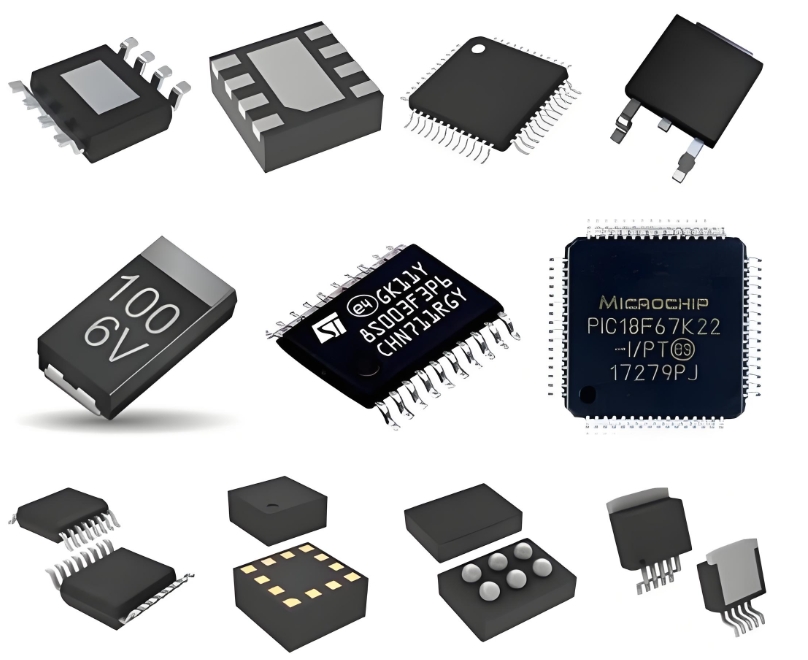
The MCP6004 integrates four independent op-amps in a compact 14-pin SOIC package, making it an efficient solution for space-constrained PCB designs. Its defining characteristics are centered on its optimized performance for battery-powered systems.
Low Power Consumption: The device features a quiescent current of just 100 µA per amplifier, making it ideal for battery-operated devices that require long operational life.
Rail-to-Rail Input/Output (RRIO): This capability allows the input and output signals to swing very close to both power supply rails (VSS and VDD). This maximizes the dynamic range in low-voltage systems, which is crucial when operating from a single supply voltage as low as 1.8V.
Gain Bandwidth Product (GBWP): With a GBWP of 1 MHz, the MCP6004 is well-suited for amplifying audio frequencies, sensor signals, and other low-frequency applications.
Low Supply Voltage Operation: It operates over a wide supply voltage range from 1.8V to 6.0V, compatible with two-cell battery configurations, 3.3V, and 5V digital systems.
High Input Impedance: This minimizes the loading effect on sensors or input signal sources.
Typical Applications
The combination of low power and rail-to-rail operation opens the door to a vast array of applications, particularly in portable and consumer electronics.
1. Sensor Signal Conditioning: The MCP6004 is perfect for amplifying small output signals from transducers and sensors, such as temperature sensors (thermocouples, RTDs), photodiodes, and pressure sensors. Its RRIO feature ensures the entire signal is captured and amplified even at low supply voltages.
2. Active Filters: A single package can be used to implement multiple filter stages, such as Sallen-Key low-pass, high-pass, or band-pass filters, for anti-aliasing or signal smoothing in data acquisition systems.
3. Analog-to-Digital Converter (ADC) Buffering: It serves as an excellent buffer between a high-impedance sensor and an ADC input. The op-amp provides a low-impedance drive for the ADC and can scale the input signal to match the ADC's input range perfectly.
4. Portable and Battery-Powered Equipment: Its ultra-low power consumption makes it a prime candidate for medical devices (e.g., portable monitors), handheld test equipment, remote data loggers, and IoT sensor nodes.
5. Voltage Followers and Summers: The four amplifiers can be configured as unity-gain buffers to isolate circuit stages or as analog adders/subtracters.
Circuit Design Guide and Considerations
While the MCP6004 is straightforward to use, adhering to good design practices is key to achieving optimal performance.
Power Supply Bypassing: Always use a 0.1 µF ceramic decoupling capacitor placed as close as possible to the device's VDD and VSS pins. For noisy environments, a larger bulk capacitor (e.g., 10 µF) may be added in parallel. This stabilizes the supply voltage and prevents unwanted oscillations.
Input/Output Protection: Although the device has internal ESD protection, inputs that might be exposed to voltages beyond the supply rails should be protected with external clamping diodes and current-limiting resistors.
Capacitive Load Drive: Like most op-amps, the MCP6004 can become unstable when driving highly capacitive loads. If driving a load greater than ~100 pF, isolate the capacitance with a small series resistor (e.g., 10-100 Ω) at the output.
PCB Layout: For best performance, use a solid ground plane, keep analog traces short and direct, and isolate high-impedance input nodes from sources of digital noise.
ICGOODFIND: The Microchip MCP6004-I/SL stands out as an exceptionally versatile and cost-effective solution for low-speed, low-power analog design. Its combination of quad architecture, rail-to-rail operation, and minimal power draw makes it an indispensable component for engineers designing modern portable and battery-powered systems, from consumer gadgets to sophisticated industrial sensors.
Keywords:
1. Low-Power Operation
2. Rail-to-Rail Input/Output (RRIO)
3. Signal Conditioning
4. Battery-Powered Devices
5. Quad Operational Amplifier

